Is That Phrase Trademarked? How Etsy POD Sellers Can Check Before It’s Too Late

“Is this phrase trademarked?”

Imagine spending months building your Etsy shop – perfecting your designs, pouring over every facet of your listings, finally getting some traction – just to wake up to a cease and desist over a phrase you assumed was just… a common saying. It happens more than you’d think. And the sellers it happens to almost always say the same thing: they had no idea it was trademarked.
Trademark and copyright law is one of those things POD sellers tend to learn the hard way. So before that happens to you, here’s what you actually need to know! We’re also including a quick checklist at the end of this article that you can save and refer back to every time you’re working on a new listing.
A quick note: this article focuses on US trademark and copyright law. If you’re based outside the US, the general principles are similar but the specifics – registration databases, jurisdictions, and dispute processes – may differ. We’d recommend checking your country’s equivalent trademark office for local guidance.
1. Trademark and Copyright Are Not the Same Thing
Most sellers know they shouldn’t slap a Disney character on a tee. But beyond the obvious stuff, trademark and copyright are two separate protections that cover two very different things, and confusing them is where a lot of POD sellers get caught out.
Copyright covers original creative work: art, illustrations, photos, written content, song lyrics, etc. If someone made it, they own it automatically, whether it’s registered or not.
Trademark covers words, names, phrases, logos, and slogans that identify a brand or product in commerce. This is where many POD sellers get caught, because a phrase that feels completely generic might have an active trademark sitting on it.
One more thing worth knowing: a single product can be protected by both. A brand’s logo might be copyrighted as original artwork and trademarked as a business identifier. That’s two separate violations for the same design.
Quick side note for POD sellers using AI-generated designs: purely AI-generated artwork cannot be copyrighted under US law — courts have confirmed that copyright requires human authorship. That goes both ways. It means someone can’t claim copyright over a fully AI-generated image and come after you for using it, but it also means your AI-generated designs aren’t protected either. If someone copies them, you’d have limited legal recourse.
2. Etsy Takes Both Seriously, But Handles Them Differently
Getting hit with either one will get your listing pulled, but what happens next depends on which type of claim it is.
If a listing is removed for a copyright claim, Etsy will notify you and give you the option to file a counter notice – a formal declaration that you believe the removal was a mistake. It’s not a guaranteed fix, and you’d be making that statement under penalty of perjury, but the door exists. (Etsy’s Intellectual Property Policy)
If it’s a trademark claim, that door doesn’t exist. According to Etsy’s own seller FAQ, your best option is to directly contact the party who filed the report and try to resolve it with them. Etsy won’t mediate. And if you want the listing back up, you’re relisting from scratch. That means losing every review and sale, along with any search ranking that that listing had earned. For a listing that’s been running for months or years, that’s a significant loss.
That said, there’s one thing worth knowing that might ease some anxiety: Etsy doesn’t accept reports from just anyone. To file a trademark claim, the rights owner has to first register their IP directly with Etsy, submitting the exact trademark, registration number, jurisdiction, and the classes of goods it covers. Etsy reviews all of it before approving anything. So by the time a claim hits your listing, it’s come from someone who has already proven ownership to Etsy’s satisfaction and is filing under penalty of perjury. This makes filing a frivolous claim through their portal a significant legal issue for whoever tries it.
3. How to check if a phrase or design is already trademarked
Good news: it only takes about five minutes to check if something is trademarked! You’ll want to do this before you list anything, so start getting familiar with the process of checking!
For phrases, words, and slogans:
Head to the USPTO Trademark Electronic Search System (TESS). This is the official US trademark database. Search the exact phrase you want to use. When results come up, the status is what matters. If it shows LIVE, the trademark is active and you need to stay away from it. If it shows DEAD, the trademark has expired or been abandoned and is generally safe to use.
Let’s use Nike as an example. Search “NIKE” on TESS and you’ll get both of these results:


The LIVE registration is on the left. International Class 025: athletic and casual clothing. That one matters a lot if you’re a POD seller. The DEAD one on the right is a cancelled trademark for watches that Nike let expire years ago.
The same brand can have dozens of registrations across different categories, some live, some dead. A DEAD result doesn’t mean the brand is fair game. It just means that specific registration in that specific category is no longer active. Always scroll through every result and check the goods and services class before assuming something is safe.
It’s also worth knowing that a phrase doesn’t have to be an exact match to get you in trouble. If your phrase is similar enough to a live trademark in the same category of goods, that can still be a problem. For example, “Mama Bear Club” might feel safe to use, but if there’s a LIVE trademark for “Mama Bear” in IC 025, using a phrase that contains it could still be a problem.
For designs and artwork:
Run a reverse image search using Google Images. Upload your design or a similar image and see what comes up. It won’t catch everything, but it’s a fast first check for whether something close to your design already exists.
And as an easy simple rule: when in doubt, don’t list it. It sounds obvious but a lot of sellers talk themselves into it anyway. If you can’t confirm something is clear, the risk isn’t worth it, especially knowing what you now know about how Etsy handles claims.
4. The gray areas that catch sellers off guard
Here’s something many sellers don’t realize: brand owners aren’t just choosing to come after you. In many cases they’re legally required to. If a trademark holder fails to actively enforce their trademark against unauthorized use, they risk losing it altogether through what’s known as “trademark abandonment.” It’s one of the reasons brands monitor platforms like Etsy so closely and file claims even against small shops. Think of it as legal housekeeping.
With that in mind, here’s where sellers most commonly cross the line without realizing it:
Using a brand name in your tags or title, even if it’s not in your design
This is one of the most common mistakes POD sellers make. If you’re tagging a listing with a trademarked brand name to drive traffic (even with something like “gifts for Nike lovers”), that can still trigger a trademark claim. The design doesn’t have to include the trademark. It can be anywhere in the listing.
“Inspired by” or “in the style of” doesn’t protect you
Adding this phrase to your title or description feels like a disclaimer, but legally it isn’t one. If the underlying design or phrase is trademarked or copyrighted, “inspired by” won’t save your listing.
Celebrity names and likenesses
Using a celebrity’s name in your title, tags, or design, even without a photo, can be a problem. Celebrity likeness rights exist separately from trademark and copyright, and many celebrities actively protect them.
Sports teams and league logos
NFL, NBA, MLB, college teams are all heavily protected. Even slightly altered versions of logos or team names can trigger a claim. There are official licensing programs if you want to sell in this space legitimately, but they’re not cheap.
Song lyrics Even a single line. Lyrics are copyrighted the moment they’re written, and music publishers are notoriously aggressive about protecting them on POD platforms.
When in doubt, leave it out. If you’re relying on someone else’s brand, name, or creative work to sell your product, that’s a sign to rethink your strategy. Besides, you want customers to find you because of your work, not by riding the coattails of someone else’s.
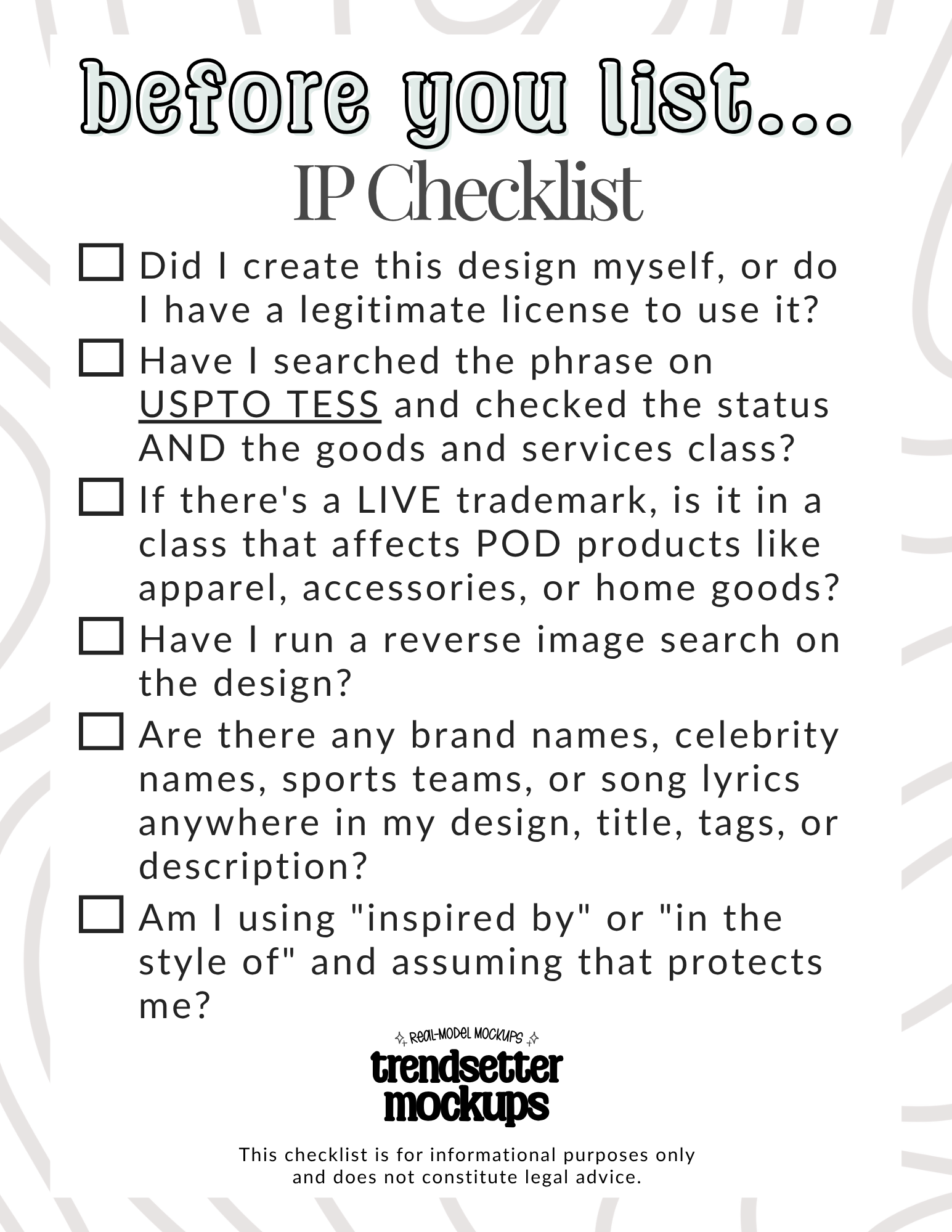
Last but not least, we have included a checklist for you. Save this page to refer to later, or download it to your device to check off every time you make a new listing!

The information in this article is for general informational purposes only and is not legal advice. IP law is complex – if you have specific concerns, we always recommend consulting a qualified IP attorney.